

Asbestos is a type of naturally occurring mineral. In its normal, rocky state, asbestos is not harmful. However, asbestos can be crushed into soft, flexible fibers, a unique attribute in the mineral world. The silky, pliable fibers can be woven into cloth, pressed into felt, and incorporated into products large and small.
The reason asbestos became such a popular component of so many industrial and consumer goods is that the mineral is fire-resistant, corrosion-resistant, soundproof and incredibly strong. It is also extremely lightweight, inexpensive to extract from the earth, and plentiful.
Exposure to asbestos in its fibrous form is known to cause a rare but very aggressive cancer called mesothelioma, as well as lung cancer, other cancers, and diseases such as asbestosis. This happens when the microscopic particles of asbestos fiber are inhaled or ingested into the body and become lodged in the lungs and other internal organs.
Where Does Asbestos Come From?
There are six distinct types of fibrous asbestos substances, all of which come from the naturally occurring rocky minerals serpentine and amphibole. Chrysotile is the only asbestos found in serpentine rock. Amosite, anthophyllite, actinolite, tremolite and crocidolite come from amphibole deposits.
The first asbestos mine in the U.S. was opened when the Johns Company, predecessor to Johns Manville, began operation of its first anthophyllite mine on Staten Island in New York in 1858. In 1899, large asbestos deposits were discovered on Belvidere Mountain in northern Vermont. By the time a hundred years had passed, six million tons of asbestos were being mined across the globe each year.
The weaving of soft, silk-like asbestos fiber into textiles launched the asbestos industry back in the 1870s. Yarns were soon developed in which asbestos fibers were dispersed across multiple strands of wool or cotton which, when twisted, created a plied yarn that was both strong and uniform in its heat- and corrosion-resistant abilities.
By 1883, asbestos textiles were mixed with rubber to create aprons and other protective garments that could be worn by foundry workers to shield against spattering molten metals, welding sparks, and the concentrated heat of blast furnaces in metalworking. This led to oven mitts, stove mats, ironing board covers and numerous other household goods such as insulation in toasters, steam irons and hair dryers. By the 1950s, many building codes in the United States required the use of asbestos, such as for stage curtains in theaters and asbestos-cement roof shingles on homes and commercial buildings.
Prior to 1960, most American-based asbestos mining operations were on the east coast, where manufacturers incorporating the fiber into their products were more plentiful. Asbestos mining ceased in the United States when the last asbestos operation, the King City Asbestos Company chrysotile mine in west central California, which until 1985 was owned by Union Carbide, closed down in 2002.
What Does Asbestos Look Like?
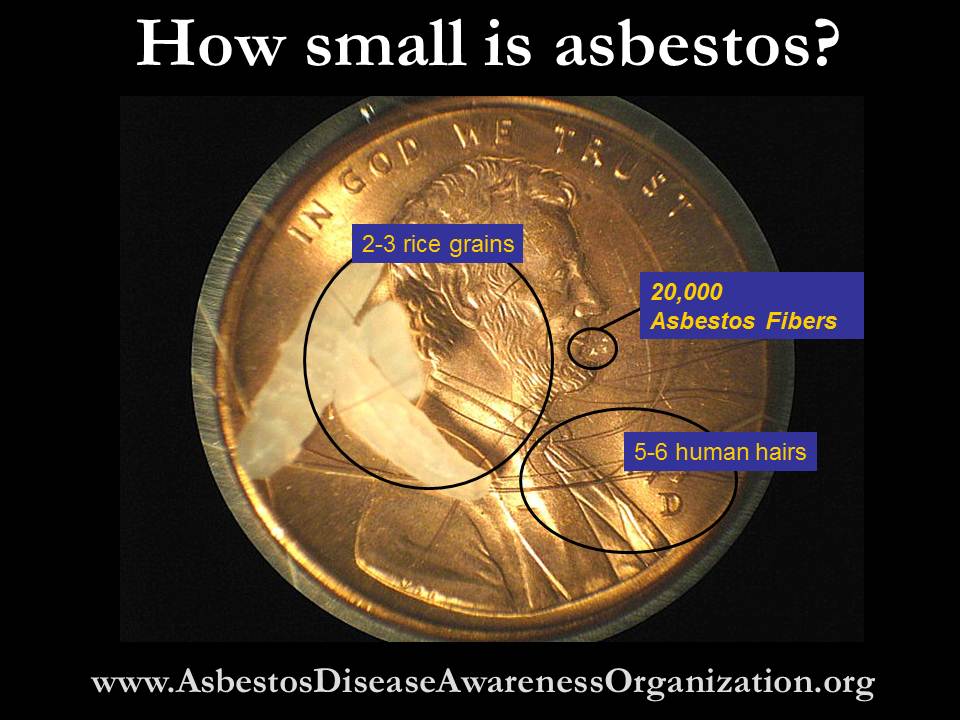 An asbestos fiber is 700 times smaller than a human hair. The mineral known as asbestos is made up of fibers so tiny that 80,000 fibers would fit onto a single grain of rice. Yet, pound for pound, asbestos is stronger than steel. Each visible asbestos fiber is composed of millions of microscopic “fibrils” which are so small they cannot be seen with the naked eye and can only be positively identified with a microscope.
Types of Asbestos
There are six distinct types of fibrous asbestos substances; all of which come from the rocky minerals serpentine and amphibole. Chrysotile is the only asbestos found in serpentine. Amosite, anthophyllite, actinolite, tremolite and crocidolite come from amphibole deposits. All can kill, but some are worse than others. They are commonly known by their colors: blue, brown, yellow, white and green asbestos.
Chrysotile Asbestos — The only member of the serpentine class of mineral, chrysotile is the most common form of asbestos and was used in approximately ninety percent of commercial products around the world. Long the preferred insulation material in asbestos cement, textiles, brake linings, clutch facings, ropes and yarns, chrysotile has curly fibers that easily become lodged in the body. These fibers appear white beneath a microscope. Although medical personnel hired by asbestos companies have argued that chrysotile is not as toxic as other kinds of asbestos, studies have confirmed, and the Environmental Protection Agency has ruled, that chrysotile is just as carcinogenic as any other type of asbestos fiber.
Amosite Asbestos – Amosite (the name stands for “asbestos mines of South Africa”) is found almost exclusively in what is now Zimbabwe and was used most often in construction-related goods. Although it appears grayish white under a microscope, amosite is typically known as “brown” asbestos, with straight, short, needlelike fibers. The second-most popular asbestos fiber for commercial applications, Amosite was far more resistant to acids and corrosive seawater than chrysotile and therefore was widely used by the U.S. Navy in insulated blankets for engines, marine turbines and other water-borne applications. It was also incorporated into asbestos-cement boards and pipes, floor and ceiling tiles, and roofing, and was popular as chemical and electrical insulation due to its superior corrosion-resistant qualities.
Anthophyllite Asbestos – Among the rarest forms of asbestos, anthophyllite is mined primarily in Finland, although deposits have also been quarried in the American states of Georgia and North Carolina. Composed of long, needle-like fibers, which are easily inhaled, anthophyllite can range from brown to yellowish in color. Due to its scarcity, anthophyllite was not used as often in consumer products, but was incorporated into some cement and insulation materials. Anthophyllite has also been found in products containing vermiculite, such as attic insulation and potting-soil amendments, as well as in talcum powder.
Actinolite Asbestos – Actinolite is typically used to make industrial pipe insulation but it is also found in a number of consumer products for the home. The fibers of this usually brownish mineral are straight. Like the vermiculite near which it is often found, actinolite is lightweight and expands when heated, making it ideal for spray-on fireproofing material used on the structural framework of parking garages and high-rise office towers. Besides brown, actinolite can appear gray, green or white, depending on its source location. In addition to fireproofing, this type of asbestos was commonly used in textured paints, wall-joint compounds, plasters and acoustical ceiling textures.
Tremolite Asbestos – Tremolite is usually found near chrysotile asbestos deposits and in talc and vermiculite mines. The U.S. Environmental Protection Agency reports that tremolite, which contaminated a major vermiculite mine in Libby, Montana, was at one time present in attic insulation in approximately 35 million homes across America. Strong and extremely flexible, tremolite was easily spun into thread or yarn and then woven into cloth, making it ideal for insulated sound-stage curtains, oven mitts, hot pads, ironing board covers, industrial turbine blankets, fireproof clothing and foundry aprons, roofing felt and tar paper. Appearing almost translucent, tremolite could have a green, brown, gray or even a whitish cast, depending on what mineral deposit it came from.
Crocidolite Asbestos – Crocidolite is blue in color and has extremely thin fibers that can easily penetrate human tissue. Experts consider this to be the most dangerous form of asbestos. Mined primarily in South Africa, Australia and Bolivia, crocidolite is more brittle than other amphibole forms, causing products that incorporated this asbestos fiber to break down and become airborne more easily. Crocidolite is also less resistant to heat, reducing its usefulness in extremely high-temperature industrial applications and making it preferable for use in spray-on insulation. The properties of crocidolite made it popular as an insulation for containers storing highly corrosive substances, such as battery acid and seawater. Crocidolite was also widely used in wire and cable insulation and as gasket material for steam pipes and valves.
What Is Asbestos Used For?
Little was known about incredibly durable and fire-resistant asbestos in prehistoric times. In fact, early cultures considered its properties to be magical. The first use of asbestos by humans can be traced to 4,500 years ago, in shards of earthenware found in Finland, which indicate that the fibrous material was used to add strength and incombustibility to early cooking vessels set over open fires.
Major asbestos production started with textiles. Ancients interwove asbestos fiber with linen thread to form primitive fireproof textiles. By 1720, Russia was using asbestos fiber in the manufacture of gloves, socks and handbags.
Commercial asbestos production is thought to have begun about 1850 in Italy, in the making of paper money and cloth. Modern industrial use began in 1871 with the construction of a factory in Germany by industrialist Louis Wertheim to transform asbestos yarn into piston rod packings, boiler casings and other goods. In 1899, Austrian industrialist Ludwig Hatschek developed asbestos cement using a wet rolling-machine process, launching an industrial juggernaut, which began with his introduction in 1900 of Eternit brand asbestos cement roof tiles.
By the outbreak of World War II, asbestos was widely used in building materials both military and domestic. The vast number and variety of products manufactured with asbestos components eventually exceeded anyone’s expectations. At the height of asbestos production in the 1960s, more than 3,000 different types of commercially available consumer products incorporated asbestos fibers to some degree.
In the Home
Widely praised for its sound absorption, resistance to heat, fire, and chemicals, and because it does not conduct electricity, the building and construction trades incorporated asbestos fibers into many products that were available to consumers at any hardware store. These goods included pipe and attic insulation, ceiling and floor tiles; interior paints, plasters, and wall-joint compound, as well as adhesives and plastics.
Roof shingles and roofing felt, tar-paper and chimney sealant all contained asbestos at one time. Exterior siding made to look like wood shakes also contained asbestos, as did attic insulation, residential boiler and furnace casings, and insulated radiator-pipe wrapping.
In the Workplace
A report from the United States Occupational Safety and Health Administration (OSHA) reveals that no toxic substance has caused more harm to the public than asbestos. From miners who quarried the raw mineral from ground to factory, to workers who labored to make floor-tile, roof shingles and other asbestos-containing products, to the homeowners who bought and installed asbestos-laden goods, millions of people have been put at risk for asbestos exposure. Approximately 27.5 million people were potentially exposed to asbestos at work between 1940 and 1970 alone. In many cases, employers intentionally withheld the dangers of asbestos from unsuspecting workers.
Whether you were a plumber or pipefitter outfitting a new home or commercial building with steam pipes and insulation, or a sheetrock finisher who mixed up (and later sanded) countless buckets of wall joint compound, or a factory worker who toiled in the country’s steel mills, steam plants, paper mills and other industrial sites, you were likely exposed to asbestos dust in the performance of your duties if your career spanned the middle of the last century. Below is a list of jobsites where the use of asbestos was prevalent from the 1940s through the 1970s:
- Floor tile mills
- Ceiling tile mills
- Asbestos textile mills
- Brake shoe factories
- Wire and cable manufacturers
- Gasket and packing manufacturers
- Boiler and turbine manufacturers
- Insulation manufacturers
- Roof tile and asphalt shingle factories
- Roofing felt and paper manufacturers
- Plastic cement and roof coating manufacturers
- Textured paint, plaster and stucco manufacturers
- Cement pipe manufacturers
- Pump and valve manufacturers
- Millboard manufacturers
- Drilling mud manufacturers
- Furnace manufacturers
- Cement siding manufacturers
- Fireproofing manufacturers
In addition, many trades were exposed to asbestos throughout the 1900s because they worked with products containing asbestos or worked around those who did. Below are some of the trades that would likely have been exposed to dust from the use of asbestos-containing materials in the vicinity:
- Insulators
- Pipefitters
- Shipfitters
- Boilermakers
- Crane operators inside manufacturing plants
- Sheetrock finishers
- Automotive mechanics
- Steel mill workers
- Steam plant workers
- Oilfield workers
- Electricians
- Floor- and ceiling-tile installers
- Roofers
- Homebuilders
In Consumer Products
Throughout the middle of the past century, the carcinogenic mineral asbestos was incorporated into numerous household products that were widely available to consumers. Products as diverse as attic insulation, textured paints, brake linings, and asphalt roof shingles all contained asbestos. Below are some of the more common consumer products that contained asbestos in the 1900s:
- Asphalt roof shingles
- Tar paper
- Roofing felt
- Plastic cement
- Flashing cement
- Mobile home roof patching cement
- Attic insulation
- Decorative cement siding
- “Popcorn” ceilings
- Acoustic ceiling tile
- Decorative interior paneling made to look like bricks
- Plaster
The Dangers and Health Risks of Asbestos
No amount of asbestos is safe to inhale and every kind of asbestos can cause lung disease. For those who worked in industries where asbestos was used on a daily basis, the risk of developing an asbestos-related disease increases the longer a person worked in that industry. For those whose bodies have a propensity for asbestos disease, a single exposure to asbestos might be all it takes to develop an asbestos disease later on in life.
Even brief or minimal exposure to asbestos can cause asbestos disease. For example, wives and children of workers who unknowingly brought asbestos dust into their homes on their work clothes (called household asbestos exposure) can develop asbestos disease many years later, even though those doing the laundry never worked with or around asbestos products themselves.
Cancers
There are several kinds of cancer that can be caused by exposure to asbestos. Below is a description of each:
Carcinoma of the Lung — Generally, the greater the length of the fibers inhaled, the more likely an individual will be to develop lung cancer or to have his non-cancerous asbestos disease progress into lung cancer. Workers who have inhaled the more durable amphibole type asbestos fibers such as amosite and crocidolite, which don’t break down as readily in the alkaline environments of the body, are more likely to develop lung cancer than workers who have been previously been diagnosed with a non-cancerous asbestos disease from inhaling chrysotile fibers.
Carcinoma of the Larynx — Like the lung, the larynx is directly in the path of inhaled asbestos fibers. Any inflammation or damage to the vocal folds, such as from tobacco and alcohol consumption or other chronic irritation, is thought to disrupt airflow enough to cause accumulation of asbestos fibers and other irritants in the larynx. Cancers of both larynx and lungs begin in the respiratory epithelium, the outer layer of tissue lining the respiratory tract which moistens and protects the airway.
Colorectal Cancer — Numerous studies have confirmed that the risk of colon cancer is elevated in males who were exposed to asbestos. The presence of asbestos-induced pleural plaques in the lungs is associated with a higher incidence of colon cancer — and in workers diagnosed with noncancerous asbestosis even more so.
In one significant, 20-year-long study, 11,821 males, who were either occupationally exposed to asbestos on a daily basis or were classified as heavy smokers (twenty or more pack-years of cumulative smoking), were followed from 1984 to 2004. The asbestos-exposed smokers had a 36 percent higher rate of colorectal cancer than smokers with no asbestos exposure. Asbestos-exposed workers with a previous diagnosis of pleural abnormalities, such as pleural thickening or asbestosis, experienced a 54 percent increased risk. In fact, the higher the degree of lung fibrosis (evidence of increased asbestos exposure) seen in the X-rays of study participants, the more significant their risk of developing colon cancer.
When compared to males in certain high asbestos exposure trades, such as insulators, shipfitters, ship scalers and electrical workers, sheetmetal workers, plumbers and pipefitters, boilermakers, construction workers and sheetrock finishers, those with 21-30 years of high asbestos exposure had a 74 percent higher risk of developing colon cancer than those with less than ten years of exposure to asbestos.
Mesothelioma — Despite different types of mesothelioma tumors and differing mesothelioma cell types, all forms of mesothelioma have in common their main cause, which is exposure to the mineral asbestos. Malignant mesothelioma is an aggressive cancer. It is difficult to treat and always fatal.
Pleural mesothelioma is the most common of the malignant mesotheliomas, accounting for about 75 percent of all cases. Pleural mesothelioma develops in the lining of the lungs, called the pleura.
Peritoneal mesothelioma develops in the lining of the abdomen, known as the peritoneum. This is the second most common type of mesothelioma, accounting for about twenty percent of all cases. Peritoneal mesothelioma is more aggressive than other mesotheliomas, spreading quickly from the abdomen to other parts of the body.
Pericardial mesothelioma is one of the most rare of the mesotheliomas. This cancer develops in the lining of the heart, known as the pericardium. Only about one percent of all mesothelioma patients develop pericardial mesothelioma.
Testicular mesothelioma develops in the lining of the testicles, in tissue known as the tunica vaginalis. It is the rarest of mesothelioma cancers, making misdiagnosis quite common.
Other Asbestos Diseases
Exposure to asbestos does not always mean you will develop cancer. But regardless of whether you develop an asbestos-related cancer or a non-cancerous asbestos disease (there are several), here are some important things to know.
First, the number of years between a person’s first exposure to asbestos and his or her diagnosis of an asbestos disease is called a latency period. It can extend from ten to 71 years, which is the time it takes for the immune system’s antibodies to build up scar tissue around each microscopic asbestos fiber trapped in our lungs, larynx, abdomen, or another organ, from which an asbestos disease might eventually develop.
In addition to cancer, a number of other asbestos diseases can also develop from chronic exposure to asbestos. Below is a list:
Pleural Plaques — Pleural plaques are areas of thickening and scarring around and between the air sacs (alveoli) in the lungs. This fibrosis usually appears on both sides of the chest, resulting in plaques which are present on the surface of the lung wall where it attaches to the ribcage and the diaphragm. By themselves, pleural plaques are benign. They do not turn into cancer and they rarely impair breathing. While only from five to fifteen percent of people who worked with and around asbestos will develop uncalcified pleural plaques twenty years after their first exposure, the number of people who develop calcified (meaning hardened and stiff) pleural plaques after thirty years jumps to between a third to half of all workers exposed to asbestos.
While plaques themselves do not cause lung cancer, some studies have shown that people who are diagnosed with pleural plaques are more likely to develop lung cancer and should therefore be screened regularly for changes to their lungs.
Diffuse Pleural Thickening — Asbestos-related diffuse pleural thickening is an extensive fibrosis of the visceral pleura, which is the delicate serous membrane covering the surface of each lung (the lung parenchyma) that also dips into the fissures between the lobes. Diffuse (meaning widespread) pleural thickening can occur at the same time as pleural plaques but usually occurs in a different part of the lung. Diffuse pleural thickening can begin to occur in workers within a year of exposure to asbestos, although generally it is not detected and diagnosed until 15 to 30 years later when calcification occurs and the fibrosis becomes easier to see on an X-ray.
Asbestosis – In 1997, nineteen medical experts from eight countries met in Finland to discuss the diversity of asbestos-induced disorders. From this meeting arose the so-called Helsinki Criteria for the definition of asbestosis as diffuse pulmonary fibrosis caused by the inhalation of asbestos fibers. All types of asbestos have been implicated in the development of asbestosis. Typically, more than twenty years elapse between the time of exposure to asbestos and the onset of symptoms, which can include chest pain and shortness of breath.
As scarring progresses around each embedded asbestos fiber, the fibrosis spreads farther and farther across the lungs until eventually the separate foci (damaged cells) link together, resulting in the widespread scarring pattern characteristic of asbestosis.
Household Asbestos Exposure
Secondhand, or household, exposure to asbestos was documented as early as 1960. It occurred when relatives of asbestos workers were themselves diagnosed with an asbestos disease, even though the relatives never worked directly with asbestos themselves. Typically, household exposure occurred when microscopic particles of asbestos, which were released by the millions into the air during installation or removal of many ordinary construction products, settled onto clothes while workers toiled at dusty jobs, such as sanding wall-joint compound, mixing powdered plaster, sawing through floor tile, cutting roof shingles or blowing dust from a wheel well when changing brakes.
Those deadly asbestos fibrils, so thin they can penetrate internal organs once inhaled or ingested, came home on the backs of workers who labored at construction, factory and industrial jobs throughout the 1900s. Once home, their spouses and other family members collected the soiled garments for washing. A majority of female mesothelioma patients report having shaken out their husbands’ dusty work clothes before putting them into the washing machine, causing thick clouds of asbestos-laden dust to rise into the air, where it was breathed in by the person(s) doing the laundry.
Then, owing to the long latency period between exposure to asbestos and the onset of symptoms, decades might go by before the person who did all that clothes-washing years ago suddenly developed shortness of breath or other symptoms of asbestos disease.
When Was Asbestos Banned in the U.S.?
In 1977, the United States Consumer Product Safety Commission (CPSC) banned the use of asbestos in wall patching compounds and artificial fireplace embers. In 1978 the EPA banned pre-molded and sprayable asbestos products.
In 1989, the EPA issued a rule under Section 6 of the Toxic Substances Control Act (TCSA) banning most asbestos products in the United States. However, the rule was overturned in 1991 by the Fifth Circuit Court of Appeals, after asbestos industry lobbyists successfully argued that there was doubt about its deadliness.
Even without an outright ban on asbestos products in the United States, product liability lawsuits eventually led U.S. automakers to significantly reduce the use of asbestos in vehicular brakes, engine gaskets and other products. By 1998, the volume of asbestos fibers used in American brake manufacturing had dropped 90 percent, to 6,000 metric tons per year, from its peak in 1978.
Despite the EPA’s inability to get asbestos banned in the United States, a number of products containing asbestos have been outlawed in this country under a variety of Federal injunctions, including corrugated paper, rollboard and flooring felt, all of which were prohibited under the Toxic Substances Control Act in 1989. Pre-molded asbestos pipe covering and block insulation, as well as all sprayed-on asbestos materials such as fireproofing, were barred under the Clean Air Act in 1973.
Is Asbestos Still Used Today?
Unfortunately, many products containing asbestos fiber are still not banned in the United States, notably corrugated cement sheets, flat cement sheets, clothing, roofing felt, vinyl floor tile, cement shingles, cement pipe, millboard, roof coatings and automatic transmission components.
Because asbestos was not banned outright, some automobile manufacturers have continued to import asbestos engine gaskets, clutch facings and friction materials, such as disk brake pads and drum brake linings from other countries for use in American automobiles.
In 2016, the Environmental Protection Agency took a historic step to prioritize a complete ban on asbestos in the United States. The agency named asbestos one of the first ten high-risk substances to be evaluated and regulated under its new Lautenberg Act, which modernizes and gives more authority to the original Toxic Substances Control Act signed into law by President Gerald Ford in 1976.
Having spent ten years reviewing more than a hundred studies of the health risks associated with asbestos, as well as hearing public comments on a proposed ban, the EPA previously determined that all forms of asbestos are a potential carcinogen at any level of exposure. The 2017 appointment of EPA head Scott Pruitt, who expressed his intention to defer to the asbestos industry soon after taking office, delayed the effort, however, and the EPA has yet to take up the subject under the subsequent administration.
How to Identify Asbestos
If you live in an older house, it is not always easy to tell if products on or in the walls and other parts of the home contain asbestos. While there are some identifying characteristics to look for, you must always err on the side of caution. It is best to get any product tested by a certified asbestos remediation expert if you live in an older home and suspect it contains asbestos.
A few home-finishing products to consider:
“Popcorn” ceilings – Starting in the 1950s, paint mixed with asbestos and cellulose, vermiculite or wood fiber was commonly sprayed or troweled onto the ceilings of household kitchens, hallways, bathrooms and bedrooms all across America. Asbestos fiber was used as a “filler” component because it increased the “bumpiness” of the texture and acted as a binding agent, making the thickened paint easier to spread without separating. The use of asbestos in textured ceiling products was so common that if your home was constructed before 1985, you should assume that any cottage-cheese like ceiling texture in your home contains asbestos.
Ceiling tiles – Perforated ceiling tile also contained asbestos. These panels typically measured two feet by two feet or two feet by four feet and were usually light in color. They were also known as acoustic ceilings. These lightweight tiles were strewn with random pinhole markings. They were sometimes glued or nailed directly to ceiling framework but were also suspended from ceilings by way of a lightweight framework. These were known as drop ceilings. In apartments and commercial buildings, drop ceilings using perforated asbestos tiles were common until at least 1980.
Floor tiles — If your home was constructed before 1975 and your floors are covered with 9-inch by 9-inch vinyl or asphalt tile, it is likely that your tile contains asbestos fibers. Asbestos was added to floor tile as a binding agent, and the fiber added fireproof and soundproof qualities, as well. Even the black glue used to stick that tile to the subfloor may have contained asbestos. Some brands of 12-inch by 12-inch asphalt tile also contained asbestos, and so did some sheet flooring.
Decorative cement siding — Beginning in the 1940s, asbestos cement boards could be purchased anywhere in the United States for use on the exteriors of homes, apartment buildings, schools, hospitals and office complexes. A number of manufacturers touted their asbestos siding as superior to anything else on the market due to its superior strength, fire protection and resistance to wood-destroying insects. Asbestos siding was very popular and came in a wide variety of decorative patterns, from woodgrain to scalloping, and in many colors.
What To Do If You Believe There is Asbestos in Your Home
If you believe there is asbestos in your home, should you panic? No. Walking on asbestos floor tile is not necessarily harmful. Interior rooms constructed of sheetrock joined together by asbestos-containing wall-joint compound is no cause for undue alarm. Living in a home with popcorn ceilings is not inherently dangerous.
Danger occurs when the asbestos fibers are disturbed and released into the air — where they can be inhaled. So don’t drag the refrigerator (or anything else) across a floor covered in asbestos tile. Don’t scrape off that textured ceiling material, rip up old floor tile or demolish old sheetrock walls without first consulting a certified asbestos abatement company to determine if asbestos fibers are present. If there is asbestos in your home, have a certified asbestos abatement expert remove or encapsulate it for you.
What To Do If You Believe You’ve Been Exposed to Asbestos
If you worked in an industry where asbestos products were manufactured, sold or utilized, medical experts say you should monitor your health carefully for symptoms of asbestos disease. Anyone who develops symptoms of asbestosis, such as shortness of breath or pain with breathing, should see a family physician or lung disease specialist. A doctor should be notified if someone who has been diagnosed with asbestosis coughs up blood, loses weight without trying to, is short of breath, has chest pain, develops a sudden fever of 101°F (38.3°C) or higher, or develops unfamiliar, unexplained symptoms.
What To Do If You Have Been diagnosed With an Asbestos Disease
If you have been diagnosed with malignant mesothelioma or another asbestos cancer, you have many important decisions to make.
- What kind of treatment should you seek?
- What kind of support system can you build to help you through this difficult time?
- How will you pay for expensive medical treatment and the travel costs to get to that treatment, perhaps clear across the country?
- How will you find the best doctor and hospital to treat your particular cancer?
- How will you support your family if you can no longer work?
- What kind of legacy will you leave to your children and family members?
These are all critical points to consider as you move forward following a mesothelioma or other asbestos cancer diagnosis. Here are some options to think about:
Seeking medical help – Malignant mesothelioma is an aggressive cancer that is exceedingly difficult to treat. Incisions to carve out tumors, remove lungs and peel away mesothelial linings from the organs they protect leave areas of exposed, raw nerve endings in their wake, which can be the source of excruciating pain. Therapies designed to knock down such a dynamic disease must necessarily be extremely potent themselves. You want to be sure your oncology team is familiar with asbestos disease and the best practices for treating your particular malignancy.
Dealing with the disease – Once a diagnosis of mesothelioma has been made, chemotherapy is sometimes recommended before surgery. Chemotherapy is usually debilitating to some degree and may include a number of serious side effects, such as nausea, mental haziness and extreme fatigue that could require the patient to rest and recover before surgery is scheduled. If surgery is performed, a recovery period of about ten weeks can be expected. Patients will spend an average of one to two weeks recovering in the hospital and the remainder of recovery at home. Physical therapy will be initiated before discharge from the hospital to teach patients breathing exercises and how to manage coughing.
Post-surgical treatments such as radiation or chemotherapy may begin before discharge from the hospital and will continue on an outpatient basis once the patient returns home. While people frequently feel more comfortable overall once surgical recovery is complete, most experience some discomfort immediately following surgery and from the side effects of adjuvant therapy.
Steps as basic as improving diet and nutrition, promoting better sleep habits and reducing inflammation and emotional stress are fundamental ways patients can help their bodies fight back and enable them to feel noticeably better at the same time. Participating in stress-reducing techniques like guided imagery, massage, meditation and yoga are also excellent ways patients can help themselves manage anxiety, fear, pain and depression.
Leaving a legacy – Fear of recurrence, and the inescapable feelings of anger, sadness, and anxiety that will accompany that fear, are inevitable consequences of facing such a serious illness. There may come a time when the cancer does return, or when all treatment options available to a patient have been exhausted. At that point, patients should consider that additional treatments are not going to improve their health or change the outcome, and that side effects from continued treatment may, instead, substantially diminish the quality of life they have left.
Once mesothelioma has progressed to a point at which there is nothing more to be gained by continuing curative treatment, hospice care can intercede to focus on quality rather than length of life. Hospice care is generally administered in the patient’s home. Such care focuses primarily on a patient’s comfort. Although cancer treatments may have ended, the side effects from some of them may continue. Hospice care focuses on relieving uncomfortable symptoms in order to allow a patient the opportunity to live life as fully and as comfortably as possible.
The children of parents taken early by diseases such as mesothelioma are frequently left feeling as though they did not get a chance to really know their parent as an adult. A legacy document, prepared on one’s own or with the aid of a dignity therapist, creates a written or recorded oral account of the events in a patient’s life that gave that life meaning or had an significant impact, documenting what dreams individuals may have nurtured for their children or themselves, their most momentous life encounters, what meaningful roles they played in their lives, and what they would like most to pass along to those they’ll leave behind in the form of life experiences or tender sentiments.
Fighting back against the asbestos companies that sickened you – According to the American Cancer Society, approximately 3,000 people are diagnosed with mesothelioma each year in the United States. It stands to reason that if you spent your career working in an industry that used asbestos, there is a chance, no matter how slight, that you might eventually be diagnosed with malignant mesothelioma or another asbestos disease. Once you or someone you love receives such a devastating diagnosis, there is much to consider. You might know that you were exposed to asbestos through your longtime job. Or you might have no idea how you were exposed to asbestos.
Filing a lawsuit –In addition to the essential tasks regarding health care set before you, there is another undertaking you must consider: filing a mesothelioma lawsuit. One of the single most important actions you can take to fight back against the corporations that willingly hid medical information about the deadly effects of asbestos fibers on the human body is to file a lawsuit against the companies responsible for your injuries. Nothing is as good a deterrent against corporate greed as hitting malfeasant manufacturers where it hurts: in their pocketbooks.
Here are some points to consider about filing a lawsuit:
Although the restriction differs from state to state, by law there is a limited time period to file a lawsuit in every state. If you do not file your lawsuit within this time period, you forever lose the right to seek compensation for your mesothelioma cancer. From the time your doctor first diagnoses your mesothelioma, most states allow only one to three years to file a mesothelioma lawsuit. This is called the Statute of Limitations.
You have probably heard the horror stories: An innocent citizen sues a business for wrongdoing and in no time his or her lawsuit has mushroomed into an expensive boondoggle with lawyers on both sides running up bills for seemingly endless telephone conferences, court hearings and back and forth letter-writing, all at exorbitant hourly rates. Choosing a firm that is conscientious about costs is an important consideration.
If you have received a mesothelioma diagnosis, you will want to choose a law firm that will handle your lawsuit on a contingency-fee basis. A contingency fee is an agreed-upon percentage of the total proceeds from the lawsuit. These proceeds might be obtained through a settlement, or a verdict, or an asbestos bankruptcy trust claim. It means you pay nothing up front, and you do not have to pay any expenses or legal fees at all unless compensation is obtained for you. If and when your lawyers are successful in achieving an award for your case, then the agreed-to percentage is taken as a fee, plus court costs and expenses. A law firm that works on a contingency-fee basis will only get paid if a positive result is obtained for you.
You will want to select a mesothelioma law firm with an impeccable track record. Choose a firm with decades of positive results for its clients, a firm that fights for what is right, and fights hard. You will want to choose a legal team that is among the best in the business, one whose cases are painstakingly researched and expertly prepared. You want your legal representatives to be thoroughly equipped to go all the way to trial with every case they file. Make sure you choose a team that doesn’t advertise for asbestos cases and then hand them off to other firms to process. Be certain to pick a firm that does all the work themselves and is proud of it.
Baron & Budd has handled the lawsuits of mesothelioma patients from every state in the union. We have an established a track record of success for our clients that goes back more than forty years. We have the resources and experience to tackle the biggest corporations and will not shy away from a fight. We have accumulated a massive database of information about worksites and asbestos companies and how individuals were exposed to those companies’ dangerous asbestos products. Our highly skilled mesothelioma attorneys specialize in representing clients who have been tragically diagnosed with this devastating disease. We represent our clients with integrity and compassion.
From the day you file your mesothelioma lawsuit until the day you receive compensation – and beyond, Baron & Budd will be here for you with the assistance and the resources you need as you battle mesothelioma and the companies responsible for causing your asbestos exposure.